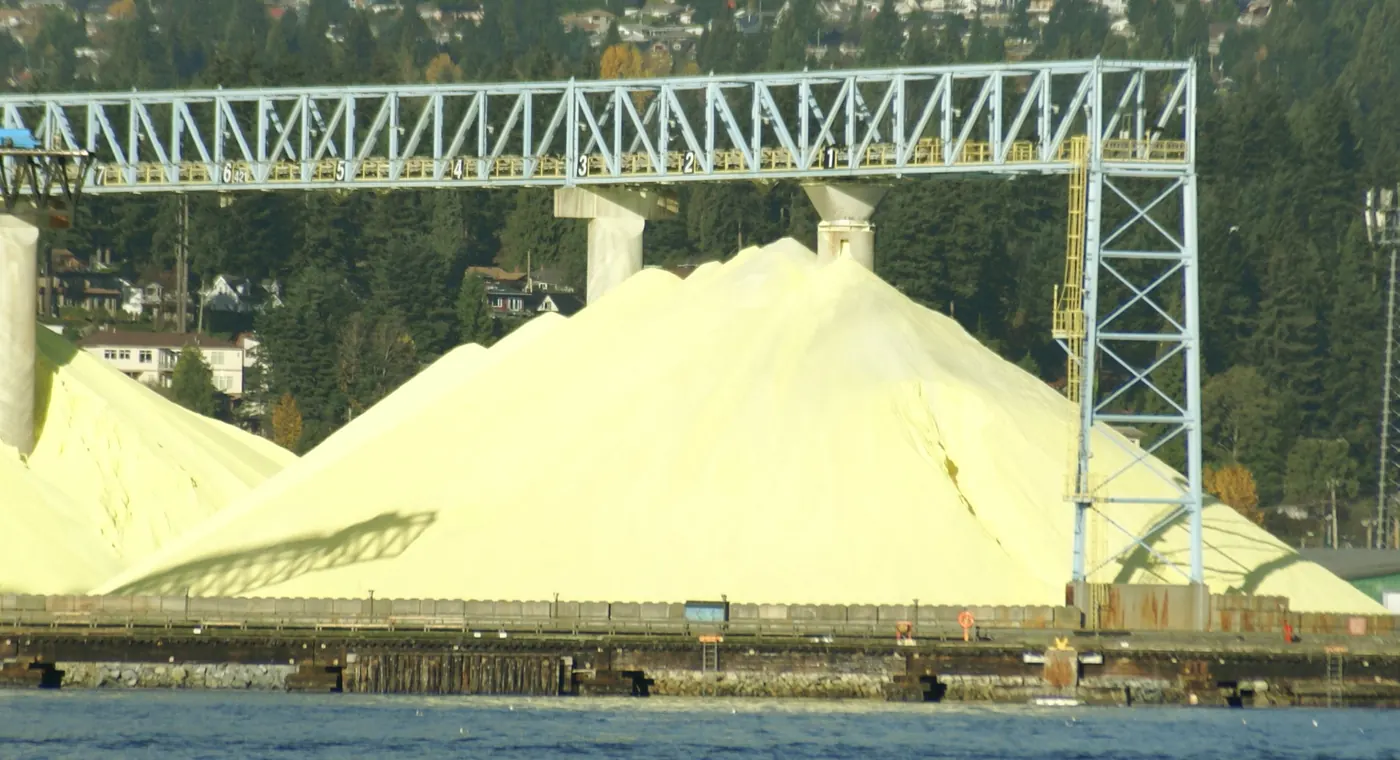
Weekly analysis for investors, traders and industry players. Five key developments reshaped the market this week:
1 — April OSPs: record levels
QatarEnergy set its April sulphur price at $570/t FOB — the highest level since 2013, exceeding the August 2022 peak by $80/t. ADNOC followed with $600/t FOB Ruwais, up $70/t month-on-month.
With freight and war-risk insurance, delivered costs rise to ~$636–638/t CFR India and ~$646–652/t CFR China. Freight rates have increased by ~118% since 28 February.
These prices remain largely theoretical. With the Strait of Hormuz effectively closed, cargoes cannot move. The market has price visibility — but not delivery certainty.
2 — Europe builds in a war premium (31 March)
Lanxess increased prices across its sulphur-based portfolio by ~40%, including ultra-pure sulphuric acid used in semiconductors, lithium batteries, and agrochemicals.
This reflects a structural shift: European industry is already embedding geopolitical risk and logistics inflation into cost bases.
3 — Zambia export controls; DRC supply crunch (1 April)
Zambia imposed sulphuric acid export restrictions to protect domestic supply.
Price divergence is now extreme:
- Zambia → ~$330/t ex-works
- DRC → >$550/t ex-works
Mining operations are under pressure to secure acid supply. Exposure ranking:
- Indonesian nickel HPAL
- DRC copper SX-EW / leach operations
- Battery and chemical value chains
4 — OCP cuts output; fertilizer supply tightens (2 April)
Morocco’s OCP advanced maintenance, impacting up to 30% of Q2 capacity.
With over 50% of sulphur sourced from the Middle East and export volumes of:
- 4.4 Mt DAP
- 2.7 Mt MAP
- ~3 Mt TSP (2025)
This is not routine maintenance — it is a global fertilizer supply constraint.
5 — Tüpraş tender: non-Hormuz pricing confirmed (3 April)
Tüpraş closed its April-loading tender at $662–672/t FCA, up $155/t from February ($487–536/t).
Conclusion: sulphur outside Hormuz is also trading above $660/t FCA. There is no low-cost supply buffer.
Big picture — one raw material, three industries
Supply competition is intensifying across:
- Indonesian nickel refiners
- African copper producers
- Global fertilizer manufacturers
Sulphur is the common constraint.
Project Blue indicates sulphur already accounts for ~50% of HPAL operating costs. Without replacement supply, production cuts could begin within weeks.
Southern Africa stockpiles (~900 kt) cover only limited demand.
Kpler data:
- 53% of Gulf sulphur exports → Asia
- 64% of Gulf ammonia exports → Asia
Key destinations: India, Brazil, China.
Price snapshot — 5 April 2026
- QatarEnergy FOB Ras Laffan → $570/t
- ADNOC FOB Ruwais → $600/t
- Tüpraş FCA → $662–672/t
- CFR India → ~$636–638/t
- CFR China → ~$646–652/t
- DRC sulphuric acid → >$550/t
- Zambia → ~$330/t
Three stakeholders — key takeaways
Investors: S&P reaffirmed Morocco’s BBB– rating but highlighted Hormuz exposure risk. OCP imports ~3.7 Mt sulphur annually, largely from the Gulf. Cost structures across fertilizers, nickel, and LFP batteries have shifted materially.
Traders: Tüpraş provides the clearest benchmark: $660–672/t FCA outside Hormuz. Short-term replacement of Middle East supply remains unrealistic. Select transit routes offer limited tactical opportunities, but margins are compressed by freight and insurance.
Industrial Buyers: Even with immediate reopening, logistics normalization may take weeks. Full supply chain recovery could take months or longer. Q2 production risks are rising for unhedged buyers.
Timeline risk
The Hormuz ultimatum deadline is 6 April, 8 PM ET. UN Security Council discussions remain unresolved.
Critical mineral supply chains — sulphur in particular — are already under severe strain.
All eyes on Monday.