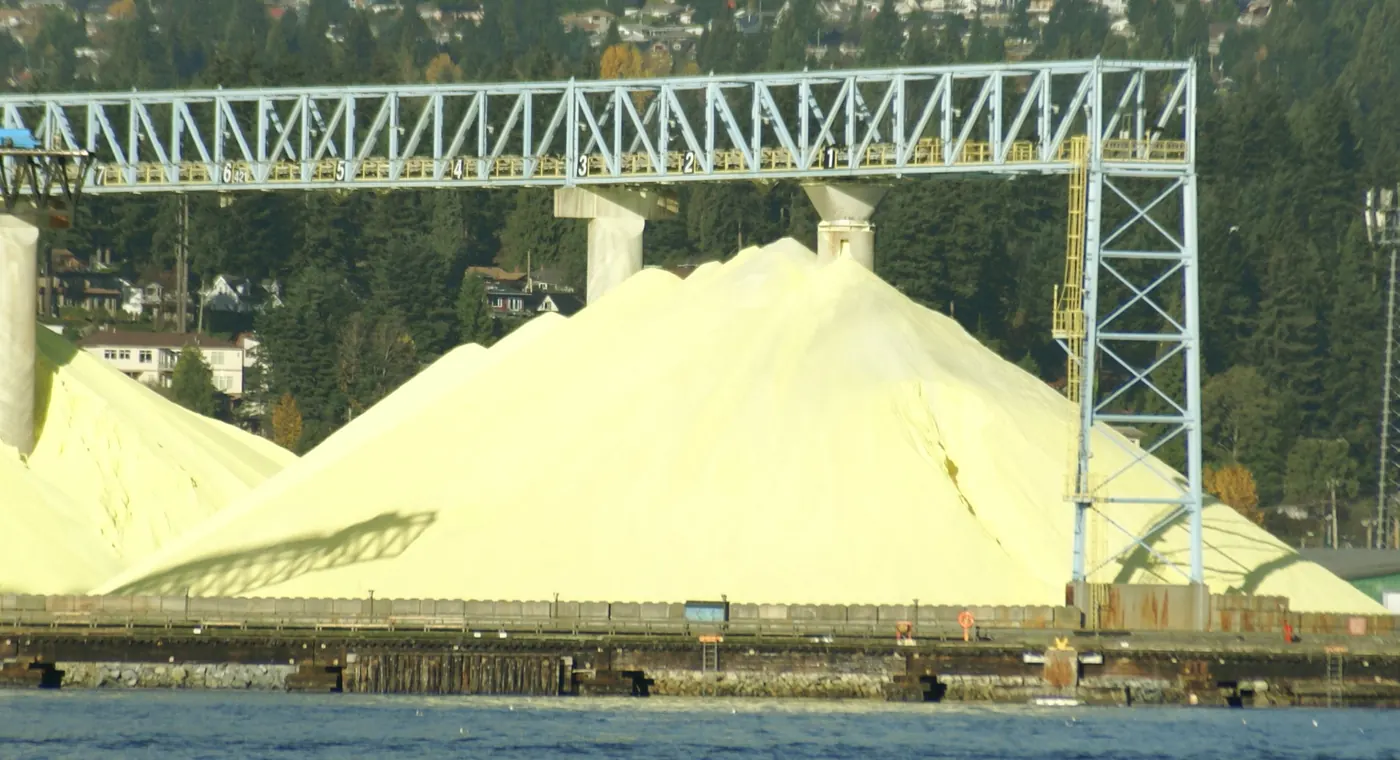
Choosing the wrong physical form can mean buying sulphur that is technically on-specification but operationally unsuitable: too coarse for a grinding circuit, too fine for safe open-air handling, or incompatible with the receiving plant's feed system. The four forms below cover the full range of commercial supply.
Granular sulphur
Granular sulphur is the dominant form in global bulk trade. Typical particle size is 3–10 mm, produced by prilling, drum granulation or pan granulation at the refinery. The coarse size minimises dust generation during ship loading, conveying and storage, making it the safest solid form for large-volume handling. Most sulphuric acid plants and fertilizer manufacturers are designed to accept granular feed; it is also the standard reference form for commodity pricing (CIF bulk vessel).
Moisture content in transit is the main quality variable. Granular sulphur in an uncovered stockpile absorbs rainwater, which raises moisture above specification limits. Buyers taking delivery from open piles should verify moisture on arrival with an independent inspector.
Prilled and pastillated sulphur
Prills are formed by spraying molten sulphur from a prilling tower, producing near-spherical particles of 2–6 mm. Pastilles are produced by cooling a thin curtain of liquid sulphur on a moving steel belt, giving flat-bottomed, dome-topped shapes of similar size. Both forms flow freely, pack predictably and are easier to handle in bagged form than irregular granules.
Prilled and pastillated sulphur is preferred where uniform particle size is important — fertilizer blending operations, for example, mix sulphur with urea or diammonium phosphate and require consistent sizing to prevent segregation. These forms are also common in 50 kg and jumbo-bag retail packaging where ease of handling matters.
Micronized sulphur (fine powder)
Micronized sulphur is jet-milled or impact-milled to a median particle size of 2–20 μm, depending on the application. At this scale, the powder has a very high surface area that determines its rate of reaction in chemical or agricultural processes.
For rubber vulcanisation, fine particle size ensures uniform dispersion through the rubber compound before curing. In agricultural fungicides, small particles improve leaf adhesion and coverage. For soil pH correction, fine sulphur oxidises much faster than granular forms because soil bacteria have more surface area to work on.
The trade-off is handling complexity. Fine sulphur dust is explosive above 35 g/m³ in air; processing and storage require earthed, enclosed systems and ATEX-rated equipment. Buyers taking micronized sulphur in 25 kg sacks or jumbo bags need adequate dust-control facilities on receipt.
Liquid sulphur
Liquid sulphur is elemental sulphur maintained above its melting point (119 °C) throughout the supply chain. It is transported in insulated road tankers, rail tank cars or, for large volumes, specialised heated vessels. The main user is the sulphuric acid industry: a contact-process plant can take liquid sulphur directly from a heated storage tank to the burner, eliminating the melting step that a solid-feed plant requires.
The logistics requirement is significant. Receiving facilities need heated storage tanks, trace-heated pipework and appropriate H₂S venting. For buyers without these assets, liquid sulphur is not practical regardless of price. It is typically only viable for plants processing large volumes on a continuous basis within reasonable tanker distance of a refinery or sulphur terminal.
| Form | Typical size | Dust risk | Best for |
|---|---|---|---|
| Granular | 3–10 mm | Low | Sulphuric acid, fertilizer, bulk commodity trade |
| Prilled / pastillated | 2–6 mm | Low | Fertilizer blending, bagged retail, uniform flow |
| Micronized powder | 2–20 μm | High | Rubber vulcanisation, agricultural fungicide, fine chemical |
| Liquid | n/a | H₂S gas | Direct-to-burner acid plants, large-scale delivery without solidification step |