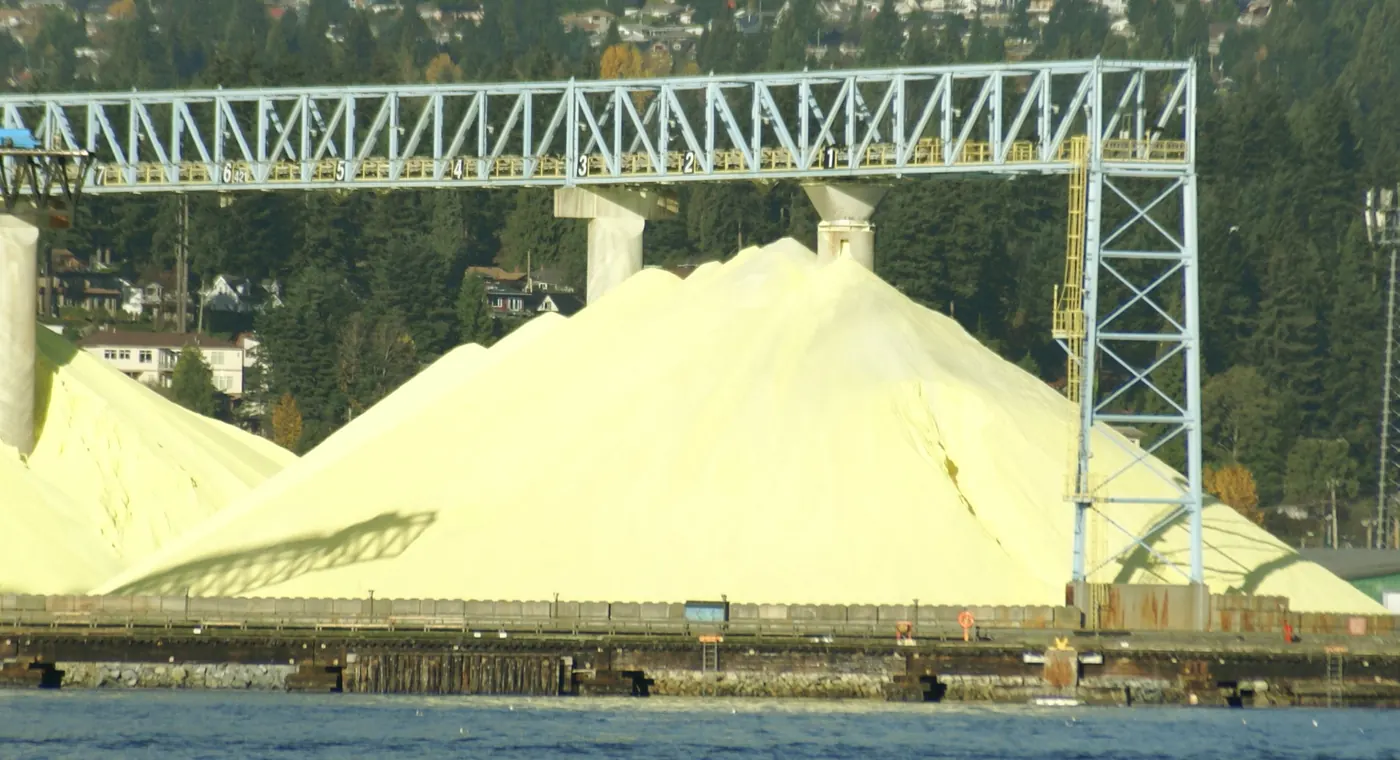
Quality disputes are the most common source of commercial conflict in sulphur trade. A cargo that passes a seller’s shipping analysis may arrive with higher moisture than acceptable, or with an ash content that clogs downstream equipment. Independent pre-shipment and arrival inspection, combined with a clear contractual specification, is the standard way buyers protect themselves.
Core specification parameters
Purity (sulphur content). Expressed as minimum elemental sulphur on a dry basis, almost always 99.5% or 99.9% by weight. Standard commercial grades are 99.5% and 99.9%. Fertilizer applications typically accept 99.5%; pharmaceutical and electronics-grade uses require 99.9% or higher. Test method: ASTM D1552 or equivalent combustion analysis.
Moisture content. Maximum is usually 0.5% or 1.0% by weight. High moisture affects weight accuracy in commercial transactions, promotes caking in storage, and is a known source of H₂S generation in enclosed spaces. Test method: ASTM D4045 (loss on drying at 40°C) or Karl Fischer titration.
Ash content. Maximum 0.03% to 0.05% is typical for commercial grade. Ash represents non-combustible mineral residue — clay, rock dust and process-related contamination. Elevated ash affects sulphuric acid quality (catalyst poisoning) and is undesirable in rubber vulcanisation. Test method: ASTM D4239 combustion residue.
Acidity (expressed as H₂SO₄). Maximum 0.005% to 0.01% typical. Free acid promotes corrosion of carbon steel storage equipment. Test method: ASTM D1019 (acid content by titration).
Arsenic, selenium and other trace elements. Required for pharmaceutical, agricultural and food-contact applications. Test method: ICP-OES or ICP-MS on dissolved sample.
Particle size for solid sulphur
- Granular / prilled: typical range 2–10 mm, tested by dry sieve analysis (ASTM C136 or equivalent). Fines (below 1 mm) are limited because they generate dust.
- Micronized powder: median particle diameter (D50) specified in microns, measured by laser diffraction (ISO 13320 or equivalent). D90 also specified. Surface area (BET method, ISO 9277) is specified for applications where reaction rate is critical.
Sampling procedure
- A representative sample is a composite of multiple increments taken at defined intervals during loading or discharge.
- Grab samples from the surface of a pile or from a hatch opening are not representative and are not acceptable for contract settlement.
- The sample is divided into three portions: one for the buyer’s laboratory, one for the seller, and one sealed reference sample held by the surveyor for potential dispute resolution.
Independent surveying
The major commodity inspection firms active in sulphur — SGS, Bureau Veritas, Intertek and Cotecna — can carry out pre-shipment inspection at the load port and arrival inspection at the discharge port. Their certificate of analysis is widely accepted for letter-of-credit payment and customs clearance purposes.
Contractual specification table
| Parameter | Typical commercial grade | Test method |
|---|---|---|
| Sulphur (dry basis) | 99.5% min | ASTM D1552 |
| Moisture | 0.5% max | ASTM D4045 |
| Ash | 0.03% max | ASTM D4239 |
| Acidity (as H₂SO₄) | 0.005% max | ASTM D1019 |
| Colour | Yellow, free from black/grey discolouration | Visual |