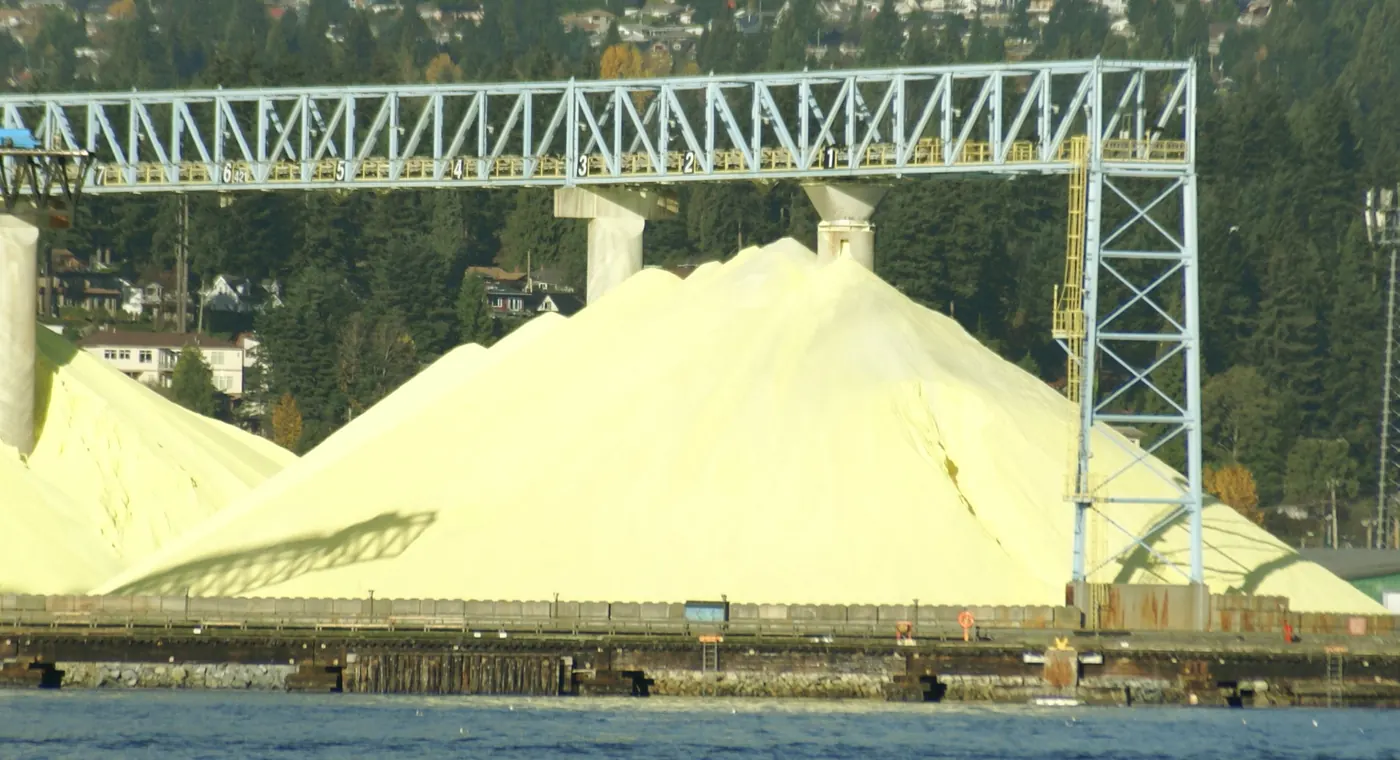
Global consumption of elemental sulphur runs above 70 million tonnes per year, the large majority recovered as a by-product of desulphurisation in petroleum refining and natural gas processing. The five sectors below account for most of that volume; understanding which grade and form each requires simplifies supplier selection.
Sulphuric acid and phosphate fertilizers
Around 90 % of world sulphur production goes to sulphuric acid (H₂SO₄), and roughly 70 % of that acid goes to phosphate fertiliser manufacture (DAP, MAP, SSP). For this use, 99.20 % S granular or prilled sulphur is standard; the wide ash and moisture tolerances of the contact-process burner mean that tighter grades add cost without benefit. Buyers are typically large fertilizer producers and commodity traders requiring consistent bulk supply and independent pre-shipment analysis.
Rubber vulcanisation
Sulphur crosslinks the polymer chains in natural and synthetic rubber during vulcanisation, creating the elasticity and durability of the finished product. Tyre and technical-rubber manufacturers generally specify 99.50 % S or better, with strict carbon and ash limits, because trace impurities affect colour, mechanical properties and odour. Both powdered and micronized grades are used; particle size distribution and the presence of dispersing agents are specified alongside chemical purity.
Fungicides, pesticides and soil amendments
Elemental sulphur has been used as a fungicide and acaricide for well over a century. In agriculture it is applied directly to soil or foliage as wettable powder, dust or liquid suspension (sulphur flower). For soil pH correction and micronutrient availability, broadcast application of fine powder is common. These uses typically require 99.50 % or higher S content; for certified organic programmes, the sulphur must also meet additional purity standards for heavy metals.
Pulp and paper
The kraft pulping process uses sodium sulphide (Na₂S), produced from sodium sulphate and elemental sulphur. Sulphur is also used to produce sodium bisulphite for sulphite pulping. Paper-grade applications generally accept 99.20 % S; moisture control is important because wet sulphur corrodes mild steel equipment in the recovery cycle.
Specialty chemicals and pharmaceuticals
Carbon disulphide (CS₂), used in viscose rayon, cellophane and as a solvent, is produced from sulphur and natural gas or charcoal. Pharmaceutical intermediates, dyes and electronic-grade chemicals require the highest purities, typically 99.90 % to 99.98 % S, with strict limits on arsenic, selenium and other trace metals. These niche volumes are small but command a significant price premium over standard grades.
Grade and form summary
| Application | Typical grade | Preferred form |
|---|---|---|
| Sulphuric acid / phosphate fertilizer | 99.20 % S min. | Granular, prilled |
| Rubber vulcanisation | 99.50 % S min. | Powder, micronized |
| Agricultural fungicide / soil amendment | 99.50 % S min. | Powder, liquid suspension |
| Kraft pulping | 99.20 % S min. | Granular |
| Specialty / pharmaceutical chemicals | 99.90– 99.98 % S | Micronized, granular |