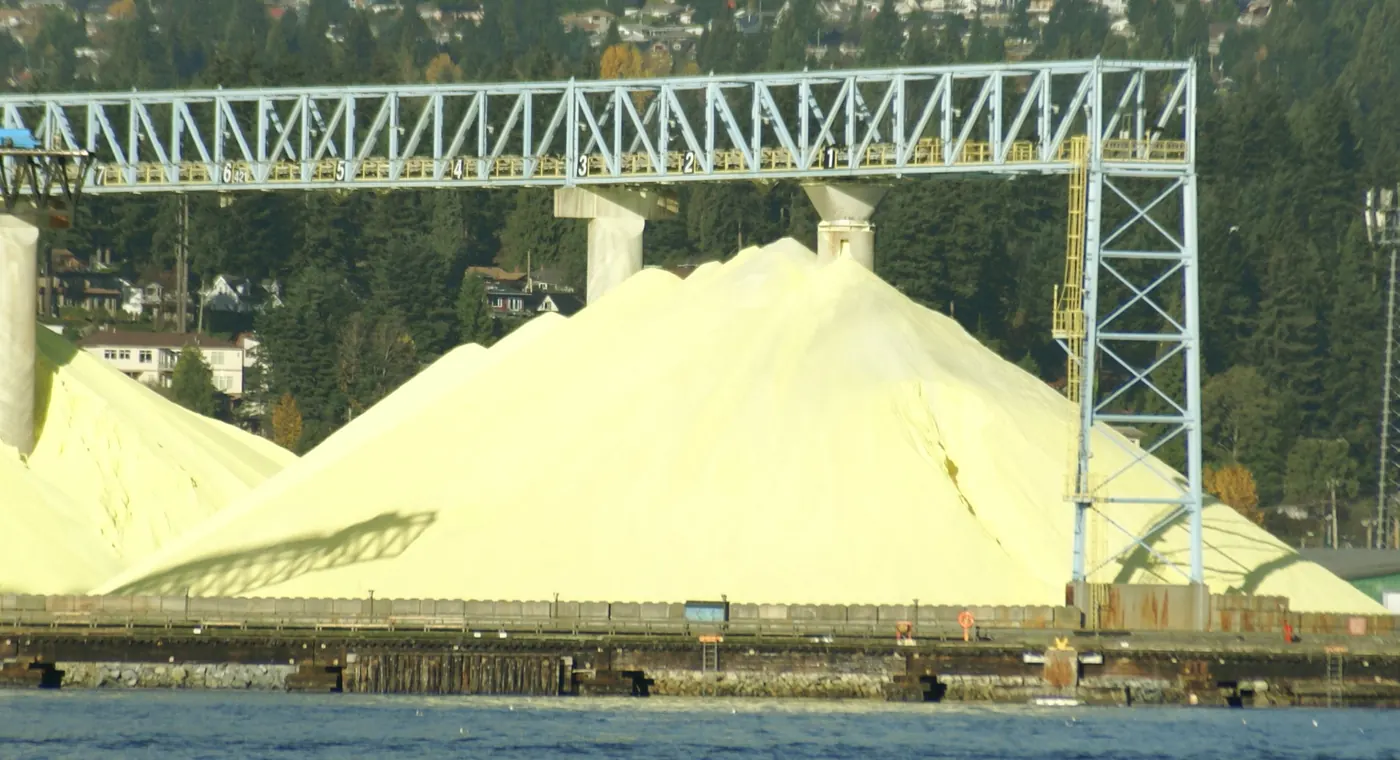
Elemental sulphur ignites at around 160 °C and burns with a blue flame releasing sulphur dioxide. Sulphur dust suspended in air is explosive above a concentration of roughly 35 g/m³. Both risks are manageable with standard precautions, and the physical form you handle — granular, prilled, powdered or liquid — largely determines which precautions apply.
Granular and prilled sulphur
Granular and prilled sulphur are the safest solid forms because their large particle size limits the surface area available for rapid oxidation. The main hazards are:
- Dust generation during transfer. Loading, conveying and bagging all produce fine particles. Enclosed transfer systems, dust extraction and covered conveyors reduce airborne concentrations below the explosive threshold.
- Spontaneous heating in large stockpiles. Very large outdoor piles can self-heat if water infiltrates and promotes bacterial oxidation. Pile heights above 10 m and poor drainage should be avoided.
- Moisture ingress. Rain on an uncovered pile raises moisture content above the specification limit, affecting delivered weight and buyer acceptance. Covered storage or sealed bags prevent this.
Micronized and fine powder sulphur
Powder sulphur carries a higher dust explosion risk. Storage facilities should be classified as dust explosion zones (Zone 22 or equivalent under ATEX or national regulations), with bonded and earthed metalwork throughout to prevent static discharge. No open flames or hot work should be permitted in the area. Quantities handled in open bags should be minimised; bulk powder is better managed in closed pneumatic systems.
Liquid sulphur
Liquid sulphur is kept in heated tanks at 125–155 °C, the range in which it flows freely. Above 160 °C viscosity rises sharply due to polysulphide formation; above 190 °C it begins to solidify and may release H₂S gas. Tanks must be insulated and temperature-controlled. Relief venting for H₂S must be treated as a hazardous gas stream, not discharged to atmosphere. Solidified ground-level spillage can be mechanically removed; burning off spills is not permitted near populated or enclosed areas.
Compatible materials
Sulphur is compatible with carbon steel, stainless steel, polyethylene and polypropylene. It reacts with copper, copper alloys (brass, bronze) and some elastomers; these should not be used in direct contact with sulphur. For bags, woven polypropylene or multiwall kraft paper with a polyethylene liner performs well. Standard jute bags without a liner are not recommended, as moisture absorption through the bag degrades the contents over time.
Classification and documentation
Elemental sulphur is classified as a Class 4.1 flammable solid under the UN/IMDG system: UN 1350 for powder and UN 2448 for molten sulphur. Granular sulphur in sealed bags often falls below the threshold for dangerous goods classification in many jurisdictions, but confirm the applicable particle-size cut-off with your freight forwarder. Safety data sheets (SDS) must accompany shipments where required by the importing country's regulations.