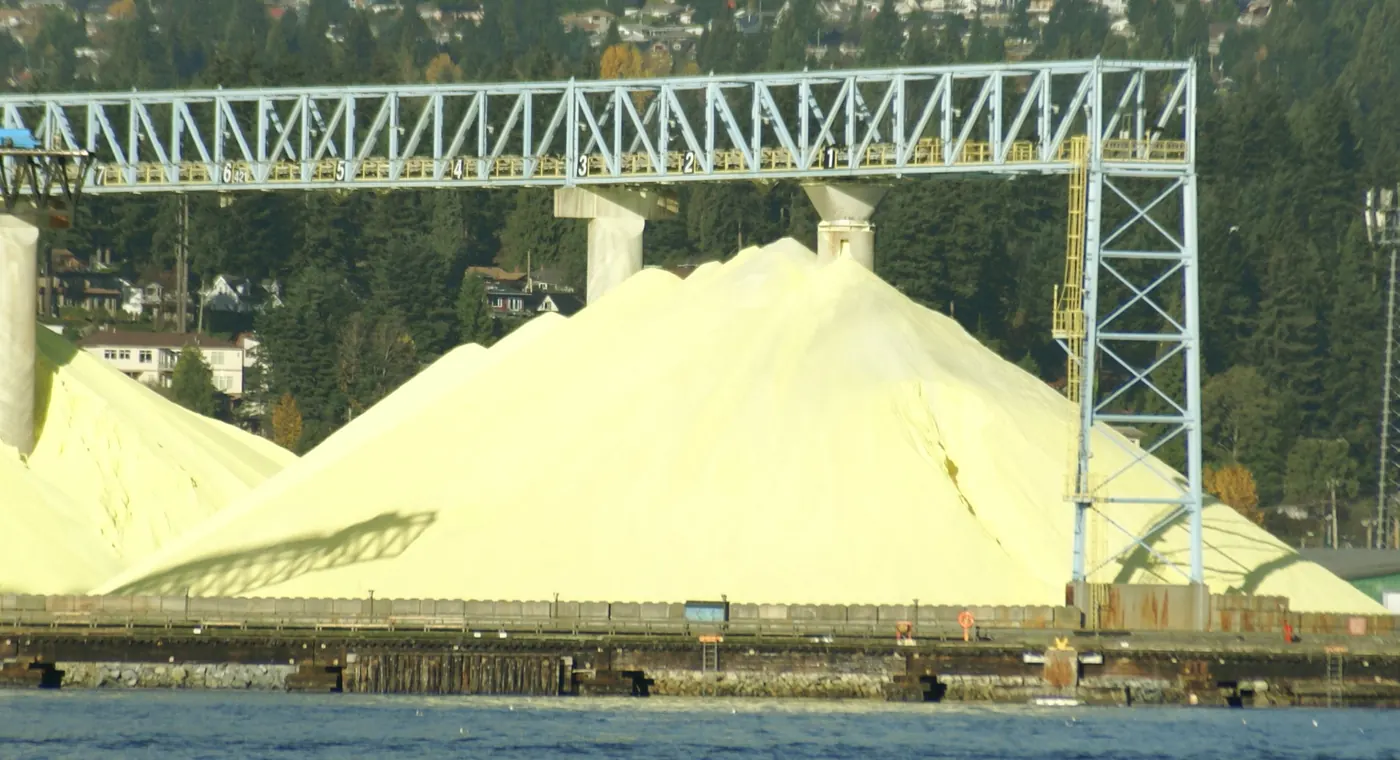
Elemental sulphur is a by-product of oil and gas desulphurisation. Unlike most commodities, its production is not set by a market decision — refineries remove sulphur because environmental regulations require them to, not because the sulphur price is attractive. This structural feature makes supply relatively inelastic in the short term and shifts most of the price action onto the demand side.
Refinery and gas-processing output
Most sulphur enters commerce through hydrodesulphurisation (HDS) at oil refineries and amine-based gas sweetening at natural gas processing plants. Output depends on how much crude and gas is being processed and on the average sulphur content of those feedstocks. When global refinery runs are high — typically when oil demand is strong — sulphur supply rises regardless of what the market needs. This can create oversupply and depress prices even when fertilizer demand is solid.
Canadian oil-sands operations and Middle Eastern sour-gas projects are among the largest single contributors to global sulphur supply. Expansions or curtailments at these sources move prices visibly.
Phosphate fertilizer demand
Roughly 85–90 % of traded sulphur is burned to make sulphuric acid, which is then used to acidulate phosphate rock into fertilizers (superphosphate, DAP, MAP). Fertilizer demand is seasonal and tracks agricultural cycles: buying activity peaks ahead of the Northern Hemisphere planting season (late winter/early spring) and ahead of monsoon application in South and South-East Asia. A strong fertilizer-production season pulls sulphur prices up; a weakening nitrogen/phosphate market pulls them down with it.
Freight and logistics costs
Sulphur trades almost entirely on a CIF basis for long-haul voyages, so ocean freight is embedded in the landed price. Bulk dry-cargo freight rates (particularly the Handysize and Supramax segments, which carry most sulphur shipments) can move the effective delivered cost by US $10–30 per tonne in either direction within a single quarter. Buyers comparing offers from multiple origins should normalise for freight before drawing price conclusions.
US dollar exchange rate
Like most bulk commodities, sulphur is priced and invoiced in US dollars. When the dollar strengthens against a buyer's local currency, the local-currency cost of import rises even if the dollar-denominated price is unchanged. Buyers in markets with weak or depreciating currencies may see their effective cost increase over the course of a contract even when headline sulphur prices are flat.
Inventory and port congestion
Because sulphur builds up continuously at refineries and gas plants, excessive inventory creates storage pressure that forces sellers to accept lower prices. Conversely, when inventory is lean — particularly at key export terminals in the Middle East, North America and Central Asia — sellers have more pricing power. Port and vessel availability, including loading constraints at export terminals, can create temporary supply squeezes that push spot prices above term-contract levels.
Typical price benchmarks
The most widely quoted reference prices are published by Argus Media and ICIS. Key markers include: Vancouver FOB (reflecting Canadian exports), Middle East FOB (reflecting Gulf producer netbacks), and Tampa CFR (reflecting US import demand, closely linked to the phosphate industry). Most long-term supply contracts use one of these assessments as a floating price reference rather than a fixed price.
Spot prices can diverge significantly from term prices during supply/demand imbalances. Buyers purchasing on a spot basis should compare against the nearest published benchmark to assess whether they are buying at a premium or discount to the market.